The Executioner’s Song by Norman Mailer

Utah
Suggested by: Emily
Traveled: August 5-19

Whew. This one was a doozy, and not just because of its 1056 page count. It’s got murder, suicide, rape, deep familial dysfunction, mental disorders, a rats’ nest of a legal system, prison, demons, and public execution. Oh, and it’s a true story. I found myself eagerly wanting to return to Mailer’s epic tome each day, but needing to take “mental health” breaks every 50 pages to look at something with, at the very least, some saturated color.

Through a painstakingly rich and thorough interview process, Mailer has told the story of Gary Gilmore, an ex-con sentenced to death by the state of Utah in 1976. After committing robbery and killing two men, Gilmore became the first man to be executed in the U.S. in decades and set off a firestorm of public interest in a person’s right to his own death. The cast of characters in this desert drama is immense, and the level of detail and internal understanding is breathtaking. After only the first hundred or so pages, I had to verify through a rabbit hole of online researching whether or not this is a fiction or nonfiction work. It is essentially nonfiction, with the understandable fictional adjustment here and there. It is a novelization of a real life story, and it is beautifully done.

But, man, it was painful to read.

Surfacing from small town 1970’s Utah, I feel the need to wipe the dust from my skin and take great gulps of free, expansive air. This is a hard story to live in. It touches on some deeply disturbing philosophical questions — do all humans have the same right to life? What is love capable of making us do — and is that really love? Are there evil forces at work in the world? Is a person to blame for the scars a flawed system has inflicted? It would be easier to just wash our hands of this discomfort and walk away, but Gilmore did not let the world do so in 1976, and the book certainly does not let us today. I was stared down by turmoil during the whole reading experience, with a glare as clear and unsettling as Gilmore’s through the bars of his cell.
 

The Glass Castle by Jeannette Walls

Nevada (with some Arizona, West Virginia and NYC)
Suggested by: Jake
Traveled: July 26-28

So rewind for a second to my not-so-glowing review of Point of Direction in Alaska. I had this to say in my main critique of the debut novel: “People don’t need to have the royal flush of shitty, unbelievable circumstances to make them interesting. They don’t even need that to make them tragic.” I argued a few weeks ago that tragedy is more compelling when it comes from traumas rooted in some relatable reality. I’d rather be moved by subtlety than overt misfortune.

Jeannette Walls turns this premise completely on its head. In her head-shakingly good memoir, The Glass Castle, she demonstrates the power of holding the royalest of flushes of terrible circumstance, and not even touching the idea of tragedy. She tells her story of a childhood rife with circumstances few of us could even visualize, with a refreshing frankness and lack of drama. She doesn’t put on a saintly cheery outlook. She doesn’t wallow, and she doesn’t whine. She asks for no credit in succeeding to love and appreciate her (most likely) bipolar mother and alcoholic father, whose wild hare ideas and eccentricities kept her and her three siblings eating out of garbage cans most of their early years. She tells it just the way it is, and the end result comes out as a genuinely optimistic tale of family that challenges our strict obsessions with normality.

As a stop in the road trip, the portions of the book in Nevada are limited to the first half, and we spend at least as much time in a decaying shack in the hills of West Virginia. But her recollections of sleeping in the dry coldness of the Nevada desert and the fondness she has for an old railroad depot with an upright piano in the front yard are memorable. It’s a masterful work coming from the humblest of beginnings — I only wish there was more of it to read.

Hawaii by James A. Michener

Hawaii
Suggested by: Reddit friend
Traveled: July 12-24

Hawaii is an afterthought most of the time. It comes in the same post-script breath as Alaska in U.S. history, always inhabiting its own corner cutout on the pull-down maps in classrooms. I had never really spent any time thinking about Hawaii, and am ashamed to say was surprised when I pulled up Google maps and realized just how far out in the middle of the Pacific it actually is.

But I just went to summer school, folks. Michener’s Hawaii was an epic crash course. It’s a generational saga, starting with the birth of its principal character — the island — bubbling up billions of years ago from a primordial vent below the ocean. The novel charts the human histories of the families who came to Hawaii and struggled to make the islands a part of their story. Polynesians from Bora Bora, New England missionaries, Chinese peasants, Japanese villagers and the modern day “native” Hawaiian, born from centuries of the melting pot’s influence.

I became seriously invested in these families. And the genius of Michener’s writing is that it never made me choose a side. With deft care and deep respect, Michener told their stories honestly. Even in the moments that forced fierce moral objections or historical tragedies, I sympathized with each new friend. Instead of righteous indignation against the tides of history, Michener’s Hawaii provoked a deeper, more human feeling. It told the story of a place, but more than that, recognized that a place’s story is fundamentally written by the lives that crack open its soils and worship its winds. It told the truth. We struggle for ourselves alone, but can never escape our undeniable ties to one another.

The book triumphs in its early beginnings and rich middle. It falters a bit as Hawaii enters more modern times, as though Michener himself was still too close to the events to make sense or beauty out of their futures. I was ready to leave Hawaii around page 700, but pushed on a couple hundred pages further out of respect for the stories of those with whom I had come so far. I now leave Hawaii with a much deeper appreciation of the islands and their history, with poignant truths that once again show the power and promise of fiction.

Point of Direction by Rachel Weaver

Alaska
Suggested by: NPR
Traveled: July 9-10

Here is the problem I had with Point of Direction. It acts as though the only problems worthy of writing about are earth-shattering, specifically terrible problems. It’s not enough to have a mother that ignores a main character except to pour her wine while she’s still in preschool — no, let’s make that terrible childhood lead her to be responsible for the death of a young hiker on a giant GLACIER and then give her brain-ripping nightmares until she hitch-hikes around and has numerous scrapes with death and then is maybe-stalked by a mystery man on a freezing, rain-whipped lighthouse in the middle of an Alaskan winter.

Ok, so I wasn’t totally impressed with Point of Direction. Clearly.

This is a point of frustration with me, and it’s not just in the books that I read. People don’t need to have the royal flush of shitty, unbelievable circumstances to make them interesting. They don’t even need that to make them tragic. Point of Direction’s protagonist, Anna, is a hyperbole. She is impenetrably covered in heavy, reaching problems that guarded against any chance for my attempted empathy. Frankly, she ended up seeming a bit selfish to me, a bit frustratingly smug in her possession of “unique” traumas.

Does it make for easy, even at times engaged, reading? Yes. I tore through this book, because it has that addictive, selfish quality that young-adult type fiction books do. I knew how it would end, and even the silly guesses I made about the mystery thread turned out to be tucked neatly together at its conclusion.

But it’s easy to redeem and heal a character who has obvious wounds and a textbook history. It’s a much more enjoyable experience to get caught up in a world where the characters have subtle scars that forge their identities, where misunderstandings and everyday betrayals create a rich portrait of life’s struggles and triumphs. I guess I wish Point of Direction would have been just a little less direct.

Housekeeping by Marilynne Robinson

Idaho
Suggested by: Rachel
Traveled: June 28-July 2

Unlike the plot-heavy epics of previous stops, Housekeeping is a book of few pages, a story that swells with daily moments and detailed simplicity. I feel as though I’ve stumbled upon an allegory, ancient in its truths and easily familiar. It’s possible that Sylvie and Ruth inhabit pages next to Cain and Noah and Moses, I just wasn’t paying close enough attention in Sunday School. The train at the bottom of a lake somewhere in Idaho winks its ghostly reflection back at the genesis tales of Eden.

The thematic richness of Housekeeping is almost too much to unpack. I don’t plan to use this touchpoint of a post to capture the depths that the story stirs, so for now, I won’t try. But there are phrases and sentences in Housekeeping that I want to hold like a hard candy on my tongue, sucking and savoring them. So I’ll let Robinson speak for herself:


“Never since they were small children had they clustered about her so, and never since then had she been so aware of the smell of their hair, their softness, breathiness, abruptness. It filled her with a strange elation, the same pleasure she had felt when any one of them as a sucking child, had fastened her eyes on her face and reached for her other breast, her hair, her lips, hungry to touch, eager to be filled for a while and sleep.” — page 11

“She had no other family, except her husband, Charley, who sat on her porch with his hands on his knees and his belly in his lap, his flesh mottled like sausage, thick veins pulsing in his temples and in the backs of his hands. He conserved syllables as if to conserve breath.” — page 21

“…it was a surprise to me when I realized that Lucille had begun to regard other people with the calm, horizontal look of settled purpose with which, from a slowly sinking boat, she might have regarded a not-too-distant shore.” — page 92

“To crave and to have are as like as a thing and its shadow. For when does a berry break upon the tongue as sweetly as when one longs to taste it, and when is the taste refracted into so many hues and savors of ripeness and earth, and when do our senses know anything so utterly as when we lack it?” — page 152

“The horns of the ferries made huge, delicate sounds, like cows lowing. They should have left a milky breath in the air.” — page 212

“If one is lost on the water, any hill is Ararat. And below is always the accumulated past, which vanishes but does not vanish, which perishes and remains. If we imagine that Noah’s wife, when she was old, found somewhere a remnant of the Deluge, she might have walked into it till her widow’s dress floated above her head and the water loosened her plaited hair. And she would have left it to her sons to tell the tedious tale of generations.” — page 172

Sometimes a Great Notion by Ken Kesey

Oregon
Suggested by: Goodreads
Traveled: June 4-23

I am coming up gasping for air, choking and gurgling, and at the same time feel myself floating on my back as water streams gently over my ears. That’s how it feels to finish reading Sometimes a Great Notion. I feel as though something enormous has just crashed down around my shoulders, but instead of thundering, I hear only empty calm. If you could inhabit that split second between a faucet plunging water into a filling bathtub, and the stillness and delicate drips that happen right after it’s turned off, that’s where you’d find me. (Or, perhaps more appropriately, the moment just after a mighty tree is felled to the ground… but I’ll stick to metaphors within my personal experience).

First off, this is a fantastic piece of writing. I wholeheartedly recommend this beast of a novel, and have been doing so to anyone who will listen during the last three weeks it has taken me to read it. Things have gone more quickly on previous road trip stops, but I had to take time with Kesey’s creation. As Charles Bowden describes the Oregon landscape in the book’s introduction, “everything is damp, lush and threatened.” This is richly descriptive not only of the setting Kesey has dreamed up, but even more so of his prose. He has woven a story with characters teeming with depth and weeds; I couldn’t help but stop and relish the smell and feel of them.

I’ve just spent three weeks in a fictional town called Wakonda, where the logging union is on strike, and the enormous Stamper family of stubborn characters continues to cut trees under a non-unionized contract. The town is roiling, the winter rains are coming, and the youngest Stamper son has returned after years back East, ready for love or revenge, or whatever can pull him out of a debilitating identity crisis.

There were moments while reading Sometimes a Great Notion when I felt like I was going crazy. The narrative style is that of weaving together first person accounts that change from one phrase to the next. Interior thoughts and spoken conversation sidle against one another for space in a sentence. I found myself slipping into a strange, halting speak-think rhythm, getting glimpses of the static that goes on in other people’s heads. Kesey makes an omelet of the book, scrambling everything to create a story that belongs together. My feeling of madness only helped me more meaningfully encounter this story of people and what they do when they’ve reached the edges and can go no further.

Read this book. Get caught up in the madness with me. And when it feels like it has gotten too loud for you to handle, Kesey will throw you a line or a moment or a corner of a moment that will settle you back into the resignation of floating.


Where’d You Go, Bernadette? by Maria Semple

Washington
Suggested by: Kaity
Traveled: May 21-25

Everything about Where’d You Go, Bernadette? went down easy. It’s written in quippy correspondences, a narrative pieced together through emails and letters dashed off to secretaries. It’s a novel I read almost without noticing, so accustomed am I to scanning messages and texts during my in-between times. Its structure made it breeze by, and its setting in Seattle’s West coast tech world was familiar enough for me to register the satire and warmly appreciate it.

Also, full disclosure, I read this book on vacation. There was this handsome dude on the towel next to me waiting to slather me down with a giant bottle of sunscreen (we’re talkin’ every ginger’s fantasy here). So yeah, the plot twists brought on by Seattle’s pervasive rain only made me feel giddier and more relaxed that I don’t live in Washington. Passive aggressive housewives and a bizarre ending in Antarctica reinforced a smug contentment with where I am in my life. I thoroughly enjoyed the humorous and neurotic world of Bernadette, if only for the moments when I got to put the book down and feel more wholly the beauty of my own day.

Bernadette was a lovely little rest stop before my itinerary turns to denser pages and some veritable classics. A perfect beach read. It even managed, in its simplicity, to sneak in some profound moments about the power of creative expression and the consequences of feeling unrooted. Refreshed, I’m back from vacation and ready for Alaska.

Wild by Cheryl Strayed

California-Oregon-Washington
Suggested by: Natalie
Traveled: May 18-20

I had a drink after work last week with a new friend of mine. It was at an upscale cocktail bar with an “Old Western” atmosphere, the type of place where the bartenders pour you $15 shots of whiskey from behind handlebar mustaches and period-style suspenders. Somewhere in the middle of my second “Punch Drunk Buck,” my friend and I started talking about daydreams we like to have, the happy places we like to visit when things get stressful. I told him my favorite: I don’t even have to go into that much detail for you, because it’s essentially the plot of Cast Away. It is overwhelmingly tantalizing to me to be marooned alone on a desert island, charged only with the act of survival. I’d get to clear away the bullshit significance of emails to answer and flowers to plant, and just straight up succeed every day by finding new ways not to die.

Clearly, we were not good enough friends yet for this.

“3 years??” my friend choked on his drink. “That’s your ideal??” 

“Well, yeah,” I reasoned. “The first couple of months would be terrible, because I’d be figuring things out and starving and thirsty and thinking I’d be rescued. I want at least a couple years to get the hang of basic stuff, and then enjoy the daily victories of being alive.”

“I guess so,” he said, eyeing me skeptically. He didn’t get it at all.

Only a few days later, I opened Wild for the first time, and immediately found someone who does. Cheryl Strayed, in her compelling account of her journey hiking the Pacific Crest Trail alone and generally completely unprepared, has an amazing story. With her life basically falling apart, completely off course, she decides to hike from Southern California to the Oregon-Washington border. Alone. 26 years old. And, oh yeah, she has never backpacked  before in her life. Somewhere in her, she knows that a journey of physical struggles and solitude will pull her out of the spiral she is in. She will be reborn. And she is! In between her toenails falling off and the rain-soaked days of trudging over rocks and bramble, she becomes firmly and gloriously rooted back into life.

Now, I’m about as far away as you can get from being a hippie. But dammit if there wasn’t something seriously soul-stirring, seriously compelling, seriously instinctual about a return to the wild. Where communing with nature doesn’t just mean a stroll in the park, but a down and dirty, desperate, raw, simple relationship with the world. Where you cannot help but recognize the beauty and pain around you and rediscover its reflection in yourself. Where the aches of your soul can be healed by new aches in your back, and the answers to some of your hardest questions are found as long as you take just one more step.

Cheryl reminded me that I am a creature. That I have a little flame of an animal inside of me. It’s the same little flame that yearns to be on an island somewhere, chewing on coconut rind and smelling fresh leaves ground between my fingers. It feels good to know that I have that little flame. I feel like going on a hike!

East of Eden by John Steinbeck

California
Suggested by: Reddit friend
Traveled: May 7 – May 15

Reading East of Eden has felt personal from the first page. I guess most fiction feels personal, a genuine relationship we get to have with minds and lives otherwise unreachable. But now deep in the reflection phase of my own move to northern California, a transition that has been stranger and much more difficult than the “You will love San Francisco“ assurances I came armed with, the stories of Eden echo moments I have almost daily. Is this shocking? Not really. The entire book is a retelling of Genesis, and far be it from me to exclude myself from the stories and patterns of the entire, collective human race. Seeing my story in East of Eden is inescapable. But still, my dust feels absolutely to be Steinbeck’s dust, the stretches of rainless sun and waves of long grasses of the Hamilton ranch must be the same that tickle these new vistas of mine. And the choices, the wrestling within oneself, the biggest fight of all for identity and absolution. Why, those are mine! The very same!!

California is home and it’s not home. It’s familiar, but with different shadows, different window dressings of desert scruff and palm fronds. The air tastes dustier than it should, and the sun is at the wrong angle. Yet it’s home. There are patios, and mothers that fill my glass before I can get up, and families gathered in rooms with clocks on the walls and jars of something colorful and pickled on the counters. People still do people-things here. They go to work and love each other. They lose touch with friends and take showers at the end of long days. I feel at home in the people. They remind me that the hills and dollhouse doors and palm trunks are just different props in their stories and sins and victories.

So yes, I am Adam Trask, and he is me, and we both came here on the promise of perfection. We came seeing a world that was born and will die in our heads. The reality is muddier. It’s harder. It is a profound feeling to realize that you don’t belong in paradise. Wherever it is, it’s not here. It can’t be. Lives are being lived here. And lives, in all their shallow soils and young loves, in their valley storms and pin-pricked mists, are too rich, too tangled, to be lived in the emptiness of Eden. We have lives to live and terrible mistakes to make. And it’s immensely comforting to know that we’ll stumble through together, even if the seasons change differently and the sky is the wrong shade of blue.

Off We Go

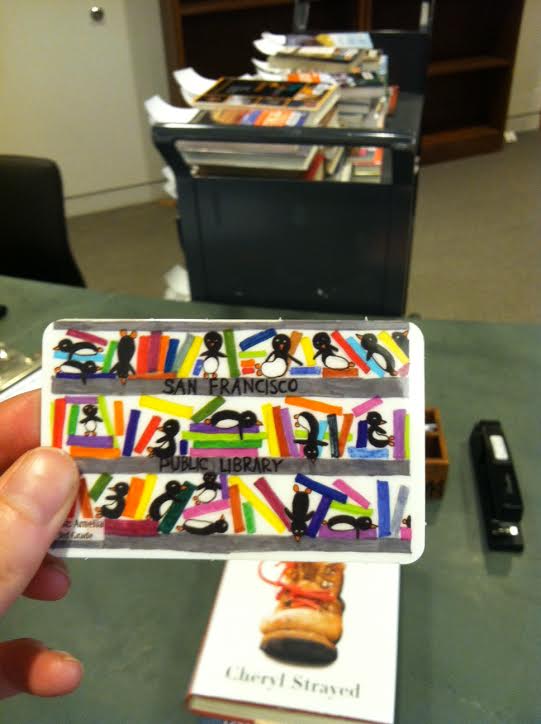
libraryStepping into the Main Library branch in downtown San Francisco, I was reminded all over again of the refuge, the cool-marble-on-a-hot-day relief, that books so enticingly offer. Yes, boys and girls, I am now an official San Francisco Public Library card-holder, which is, funnily enough, my first real documented proof that I now lay my head here in San Francisco. Renting a no-lease month to month room in a house of 9 roommates, my car sold with no need to change my driver’s license, this library card is really the first tiny root of my time here. It’s the only clue in my wallet that my life is being lived in odd, bright colors, warmer air now filling my lungs.

More importantly, it means I am ready to start my Readable Road Trip!

It seems only fitting to start in California, a place that in its vastness seems ungraspable and strange to me still. Leading me back to a row of stacks, the librarian manning the information desk chirped earnestly, “Oh East of Eden! That should be required reading for every Californian! It just puts you so in touch with the state.” I couldn’t have asked for a better review, a more reassuring moment as I buckle my seatbelt for this American tour in ink and deliciously sturdy pages.

So, I’ve got Steinbeck in hand, an excellent companion for the first leg of my trip, I’d say. I’ll be sharing my lit-inerary  (too much book/roadtrip punning? Ok, ok last one, promise) for the first part of my journey — California, Oregon, Washington, Idaho — very shortly. Thank you thank you thank you to everyone who has suggested books so far! I can’t wait to get started.